
Hello! This is  id:yohfee from the Mackerel CRE team. I'm excited to share the details of our latest update.
- Filter by status in Span Detail Search for Trace Details
- Improved visibility for Event and Link tabs in Trace Details
- Scope tab in Trace Details displays information beyond Attributes
- AWS Integration supports metrics for AWS Lambda executions exceeding 10 minutes
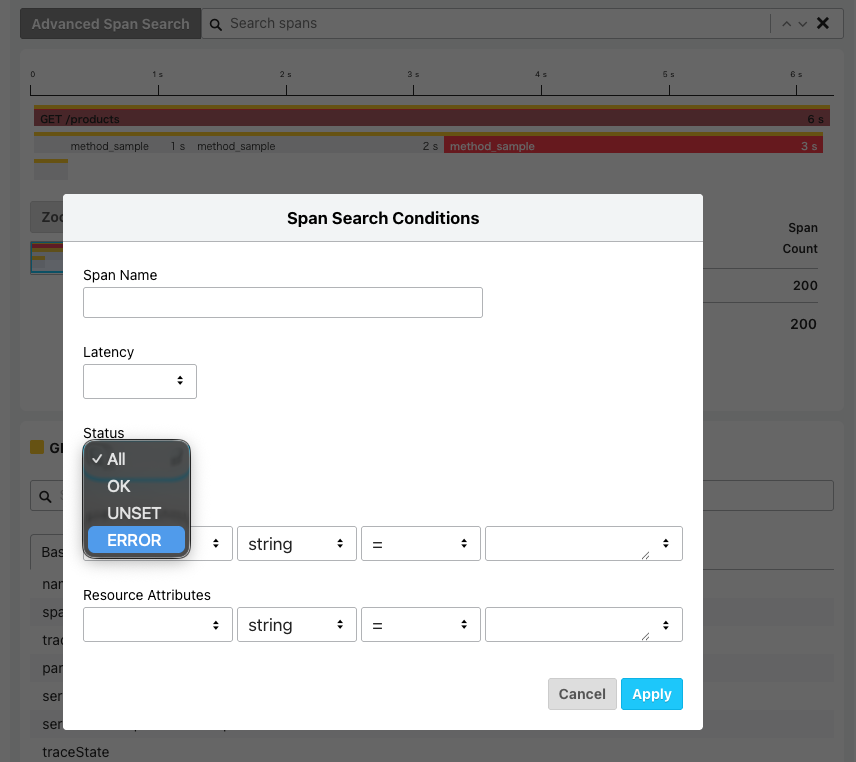
Filter by status in Span Detail Search for Trace Details
We have added "Status" as a search condition when searching for spans within the APM Trace Details. With this update, you can now filter spans by specific statuses, such as locating only those where errors have occurred. This is particularly useful for quickly pinpointing specific states within complex traces containing a high volume of spans.
Improved visibility for Event and Link tabs in Trace Details
In the Event and Link tabs of the APM Trace Details, entries are now displayed grouped by item. Previously, multiple items were listed in a flat format with indices, which sometimes made it difficult to distinguish boundaries between entries. This update makes the separation between items visually clear, allowing for a more intuitive understanding of the content.

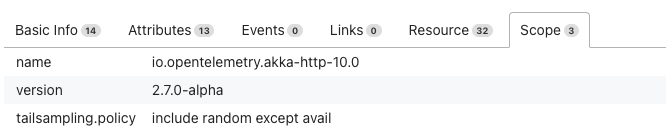
Scope tab in Trace Details displays information beyond Attributes
The Scope tab in the APM Trace Details now displays fields such as Scope Name, Schema URL, and Version. This allows you to accurately identify which library was used for instrumentation and its specific version for each span. This is highly effective during troubleshooting when you need to pinpoint the source of instrumentation.
For more details on Instrumentation Scopes, please refer to the following documentation:
AWS Integration supports metrics for AWS Lambda executions exceeding 10 minutes
Previously, there was a limitation in the AWS Integration where metrics could not be retrieved from AWS Lambda functions with execution times exceeding 10 minutes. With this update, metrics can now be successfully collected even for executions lasting longer than 10 minutes. This enables consistent metric collection and visualization for functions that were previously difficult to monitor, such as long-running batch processes or data processing tasks.
